The minimal DFA
A second important consequence of the Myhill–Nerode theorem comes from the proof of the Myhill–Nerode theorem, when it defines a DFA $A_{\equiv_L}$ for a regular language $L$. If the Myhill–Nerode equivalence classes are about distinguishable prefixes with respect to $L$, this suggests that a DFA recognizing $L$ will need at least as many states as $L$ has Myhill–Nerode equivalence classes. Since these equivalence classes correspond to the states of $A_{\equiv_L}$, which means that any DFA that recognizes $L$ must have at least as many states as $A_{\equiv_L}$.
For example, recall that we showed that we can use the product construction to obtain a DFA that recognizes the intersection of two regular languages. If the two languages have DFAs of size $m$ and $n$, then the product construction gives a DFA with up to $mn$ states. But do we really need that many? We can show that there exist languages for which we do need all of those states.
For all $m,n \geq 1$, there exist regular languages $L_m$ and $L_n$ recognized by a DFA with $m$ and $n$ states, respectively, such that a DFA that recognizes $L_m \cap L_n$ must have at least $mn$ states.
Let $\Sigma = \{a,b\}$ and consider the languages
\begin{align*}
L_m &= \{w \in \Sigma^* \mid |w|_a = 0 \pmod m\}, \\
L_n &= \{w \in \Sigma^* \mid |w|_b = 0 \pmod n\}.
\end{align*}
Then $L_m$ can be recognized by a DFA with $m$ states and $L_n$ can be recognized by a DFA with $n$ states (you can try to find the DFAs yourselves as an easy exercise). Then
$$L_m \cap L_n = \{w \in \Sigma^* \mid |w|_a = 0 \pmod m \wedge |w|_b = 0 \pmod n\}.$$
So we need to consider the equivalence classes of $\equiv_{L_m \cap L_n}$.
We will consider strings $a^i b^j$ with $0 \leq i \lt m$ and $0 \leq j \lt n$ to be our representatives for the equivalence classes. To show that these are all distinct, we consider two words $x = a^i b^j$ and $y = a^k b^\ell$ with $0 \leq i, k \lt m$, $0 \leq j, \ell \lt n$, and $x \neq y$. This means that $i \neq k$ or $j \neq \ell$ (or both). We suppose $i \neq k$; the $j \neq \ell$ case follows a similar argument.
We choose the word $z = a^{m-i} b^{n-\ell}$. Then $xz \in L_m \cap L_n$ but $yz \not \in L_m \cap L_n$. To see this, the number of $a$s in $xz$ is $i + m - i = 0 \pmod m$ and the number of $b$s in $xz$ is $j + n - j = 0 \pmod n$. But the number of $a$s in $yz$ is $k + m - i \neq 0 \pmod m$ if $k \neq i$. So $z$ distinguishes $x$ and $y$.
This means that there are at least $mn$ pairwise distinguishable Myhill–Nerode equivalence classes ($i$ can range from a to $m-1$ and $j$ can range from a to $n-1$).
Since we know that the product construction has at most $mn$ states, together with this result, we’ve also just shown that there’s a DFA for $L_m \cap L_n$ that has exactly $mn$ states.
This leads to the notion of a minimal DFA, in terms of the number of states it has, for a language. So it’s clear from this that any minimal DFA will have as many states as there are Myhill–Nerode equivalence classes for its language, but we can actually say something stronger than that: the Myhill–Nerode DFA is the only minimal DFA for its language.
Let $L$ be a regular language. The DFA $A_{\equiv_L}$ is the unique minimal DFA for $L$ up to isomorphism.
Let $A = (Q,\Sigma,\delta,q_0,F)$ be a minimal DFA for $L$. Recall that the equivalence classes of the relation $\sim_A$ correspond to states of $A$. By Lemma 11.17, $\sim_A$ refines $\equiv_L$ and therefore, the index of $\sim_A$ must be at least the index of $\equiv_L$. Since we assumed $A$ was minimal, this means that $A$ has exactly as many states as $A_{\equiv_L}$.
Now, we need to show that there is a correspondence between states of $A$ and states of $A_{\equiv_L}$. Let $q \in Q$. Then $q$ must be reachable from the initial state $q_0$, since otherwise, we can remove it. This means there exists a word $w \in \Sigma^*$ such that $\delta(q_0,w) = q$. Then $q$ corresponds to the equivalence class for $[w]$.
Assuming it’s computable, the existence of a minimal DFA and the fact that a regular language has a unique minimal DFA gives us a way to test whether two DFAs or NFAs or regular expressions correspond to the same language: just turn the two objects into a minimal DFA and if they’re the same, then they accept the same language.
Luckily, the minimal DFA can be computed, and even better is that it is efficiently computable. The algorithm with the best worst-case time complexity is Hopcroft’s partition refinement algorithm (due to Hopcroft in 1971) which for an $n$-state DFA has time complexity $O(n \log n)$.
However, we will instead work through the more straightforward algorithm that Kozen gives in Chapter 14 of the textbook. The basic idea behind this is to try to identify states in the DFA that are indistinguishable.
Let $A = (Q,\Sigma,\delta,q_0,F)$ be a DFA. For states $p,q \in Q$, we say that $p$ and $q$ are indistinguishable if for all $w \in \Sigma^*$, $\delta(p,w) \in F \iff \delta(q,w) \in F$.
A consequence of this definition is that if $p$ and $q$ are indistinguishable, then $p$ and $q$ must correspond to the same Myhill–Nerode equivalence class and we can replace both states with a single state. Now, as stated, this seems difficult to do (verify for all strings in $\Sigma^*$), so we can reframe this property in terms of distinguishability.
Let $A = (Q, \Sigma, \delta, q_0, F)$ be a DFA. Two states $p,q \in Q$ are said to be distinguishable if
- $p \in F$ and $q \not \in F$,
- $p \not \in F$ and $q \in F$, or
- $\delta(p,a)$ and $\delta(q,a)$ are distinguishable for some $a \in \Sigma$.
Notice that we get this by negating the definition of indistinguishability and implicitly setting up the definition inductively on strings. This leads us to our algorithm for determining distinguishability of pairs of states, which was first formulated by Moore in 1956.
Given a DFA $A = (Q, \Sigma, \delta, q_0, F)$,
- Initialize a table for (unordered) pairs of states $\{p,q\}$.
- For all pairs of states $\{p,q\}$ with $p \in F$ and $q \not \in F$, mark the corresponding entry.
- Repeat until there are no more changes: For each unmarked $\{p,q\}$, for each symbol $a \in \Sigma$, if the pair $\{\delta(p,a), \delta(q,a)\}$ has been marked as distinguishable, mark $\{p,q\}$ as distinguishable.
- The unmarked pairs that remain after this process are indistinguishable.
Here is an example. We have the following DFA.
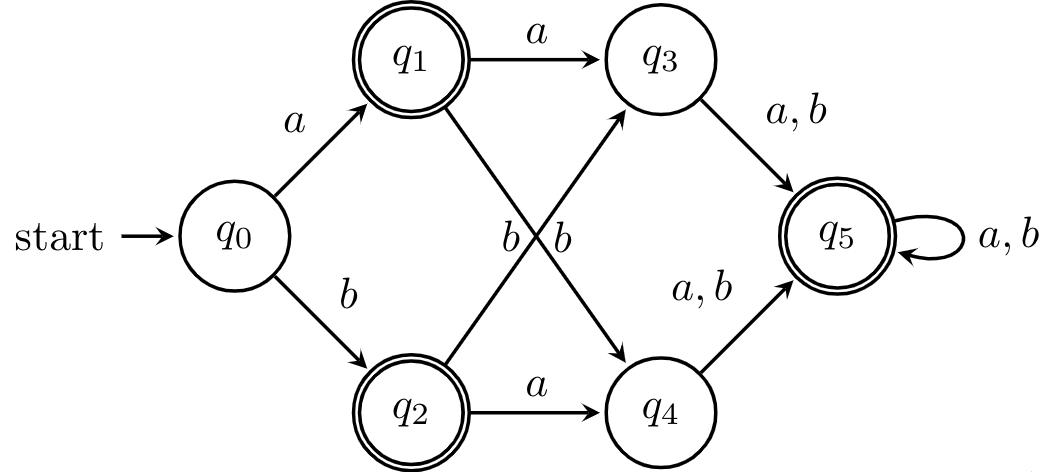
First, we set up our table and consider the first iteration of our algorithms. Note that since pairs are unordered, we only fill half the table, so to distinguish unmarked cells from empty cells, we use -. Marked pairs of states are marked by which round of iteration they were marked in, for demonstrative purposes.
| | $q_1$ | $q_2$ | $q_3$ | $q_4$ | $q_5$
|
|---|
| $q_0$ | 1 | 1 | - | - | 1
|
| $q_1$ | | - | 1 | 1 | -
|
| $q_2$ | | | 1 | 1 | -
|
| $q_3$ | | | | - | 1
|
| $q_4$ | | | | | 1
|
Next, we consider each pair of unmarked states and determine whether each pair reaches a marked pair. We have that $(q_1,q_5)$ and $(q_2,q_5)$ get marked in this phase, because $(\delta(q_1,a), \delta(q_5,a)) = (q_3,q_5)$ and $(\delta(q_2,a), \delta(q_5,a)) = (q_4,q_5)$, which have been marked distinguishable.
The reasoning here is simple: suppose that a pair wasn’t distinguishable. Then, because the “reaching the same state relation” $\sim_A$ is right-invariant, reading any word from the two states should get us to indistinguishable states. But clearly, this isn’t the case, since reading $a$ brings us to a pair of distinguishable states. It’s not too hard to see that we can extend this argument inductively.
| | $q_1$ | $q_2$ | $q_3$ | $q_4$ | $q_5$
|
|---|
| $q_0$ | 1 | 1 | - | - | 1
|
| $q_1$ | | - | 1 | 1 | 2
|
| $q_2$ | | | 1 | 1 | 2
|
| $q_3$ | | | | - | 1
|
| $q_4$ | | | | | 1
|
We do another round of this, taking into account the new pairs of distinguishable states.
| | $q_1$ | $q_2$ | $q_3$ | $q_4$ | $q_5$
|
|---|
| $q_0$ | 1 | 1 | 3 | 3 | 1
|
| $q_1$ | | - | 1 | 1 | 2
|
| $q_2$ | | | 1 | 1 | 2
|
| $q_3$ | | | | - | 1
|
| $q_4$ | | | | | 1
|
At this point, we’re finished because and we have two pairs of states that are indistinguishable. We can merge these states safely to get the following DFA.

An initial analysis of this algorithm puts it at something like $O(|\Sigma|n^4)$, where $n$ is the number of states in the DFA: there are $\binom n 2$ pairs of states and each iteration of the algorithm adds 1 pair in the worst case. A more careful analysis gets us down to $O(|\Sigma| n^3)$ via a not so obvious argument that the number of iterations is the length of the shortest distinguishing string for the last distinguishable pair—this happens to be no more than $n$. Then if you are slightly more clever, we can get this down to $O(|\Sigma| n^2)$, by maintaining a list of pairs $\{p',q'\}$ for each pair $\{p,q\}$, with $p' = \delta(p,a)$ and $q' = \delta(q',a)$ for some $a \in \Sigma$. Then, once the lists are built, we can mark pairs by going through the list in one go.
By virtue of being a polynomial-time algorithm, we’ve shown that we can consider DFA minimization to be “efficient”. So we can take for granted that we can efficiently determine whether two DFAs recognize the same language. For NFAs and regular expressions, things are a bit harder because the determinization process can lead to exponential state blowups. (In fact, while this puts DFA equality in $\mathsf P$, NFA and regular expression equality are actually $\mathsf{PSPACE}$-complete.)